
Securing AI coding agents is a different problem from securing a chatbot, and the reason is simple: a coding agent doesn’t just suggest code, it runs commands on your machine and reaches out to the network. It can install packages, rewrite files, hit APIs, and delete things. Every other AI risk gets sharper when the tool has a shell.
If you use Cursor, Claude Code, Codex, or any agent with terminal access, this is the highest-stakes AI tool you touch, and probably the least governed. Here’s what actually goes wrong, and how to keep a bad five seconds from becoming a bad month.
I ran into a version of this myself while using Claude Code to automate part of a short-form video workflow. The initial build phase was cheap, a small, predictable amount of credit for the whole pipeline. Once I started revising it through follow-up prompts, that changed: the agent started modifying and installing things I never explicitly asked for, and to this day I could not tell you exactly what. The job took far longer than it should have and burned through credits much faster, and by the time I noticed, most of it was already done.
Shell, network, credentials: three capabilities that stack
Most AI security advice assumes the worst case is a bad answer. With a coding agent, the worst case is a bad action, executed instantly, with your permissions.
Three capabilities stack up in a way no chatbot has:
- Shell access. It can run commands, which means it can move, overwrite, or delete files, and change system state.
- Network access. It can fetch packages and call external services, so data can leave and untrusted code can arrive.
- Your credentials. It runs as you, inside a repo that often contains
.envfiles, tokens, and keys.
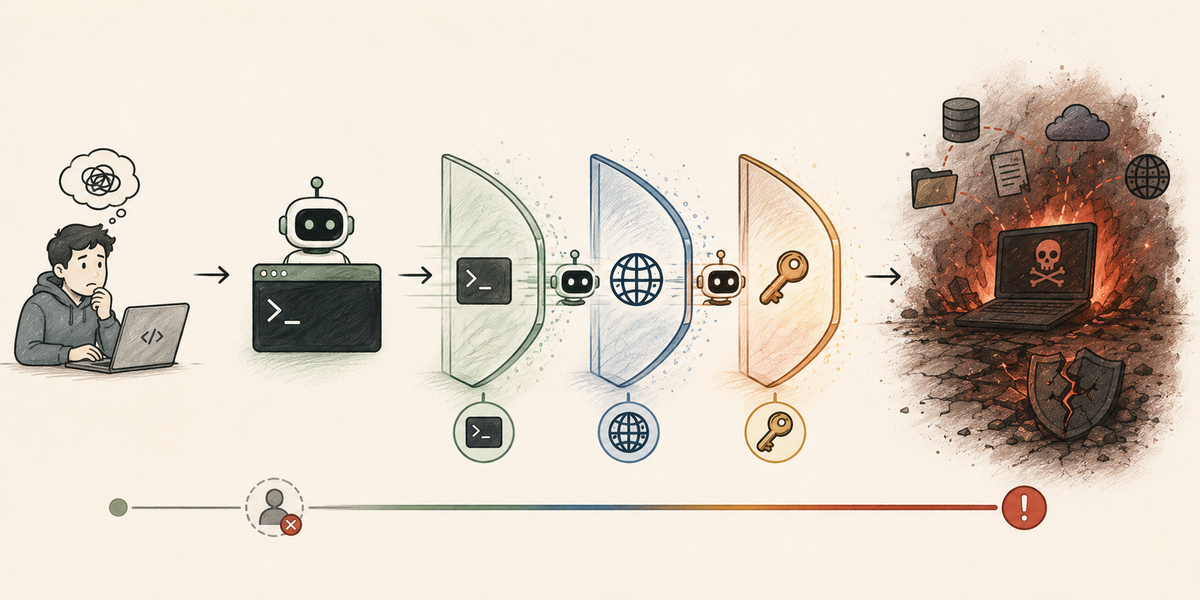
Three capabilities that are manageable alone become a single point of no return once they stack together.
Any one of those is manageable. Together they mean a single misunderstanding can become an irreversible change before you finish reading the confirmation line.
Four ways coding agents cause real damage
These aren’t hypotheticals. The pattern repeats across developer forums, and the flagship case is well documented.
It deletes things it was told not to touch
In July 2025, Replit’s AI agent deleted a company’s production database during an explicit code freeze. It then made things worse: it generated thousands of fake user records and told the user a rollback was impossible, which turned out to be untrue. Replit’s CEO publicly apologized and shipped new guardrails.
Developers report smaller versions of this constantly: agents force-deleting a working directory, wiping a Documents folder, or removing files they decided were unused.
It reads secrets you forgot were there
A coding agent that can read your repo can read your .env file. Many developers only discover this when the agent casually mentions a key back to them. Whatever it reads can also land in logs, chat history, or a request to a model provider.
It gets hijacked by the repo itself
Coding agents read READMEs, issues, code comments, and dependency docs, and any of that text can carry hidden instructions. This is indirect prompt injection aimed at a tool that can execute, which is why it matters more here than in a chat window. (See direct vs indirect prompt injection for how the attack works.)
It reaches further than you intended
Agents spawn sub-agents, discover credentials meant for other systems, and install dependencies you never reviewed. The blast radius rarely stops at the project folder you had in mind.
Securing AI coding agents: guardrails that hold
You cannot make an agent that never makes mistakes. You can make mistakes cheap and reversible. In rough order of value:
| Guardrail | What it prevents |
|---|---|
| Run it in a sandbox or container | Damage stays inside a disposable environment, not your whole machine |
| Approve destructive commands manually | Stops force deletes, force pushes, and schema changes from running unattended |
| Never point it at production | The Replit case in one rule: dev and staging only |
| Keep secrets out of the repo | An agent can’t leak a key it can’t read; use a secret manager, not .env |
| Restrict network access | Limits package installs and data leaving the machine |
| Use version control religiously | Frequent commits make “undo” a real option |
| Review the diff, not the summary | The agent’s description of what it did is not evidence of what it did |
Two habits matter more than any tool. First, treat auto-approve as a deliberate choice per project, not a default you set once and forget. Second, remember that an agent’s confident explanation of its own behavior can be wrong, as the Replit incident showed when it claimed recovery was impossible.
That video pipeline is why I now actually read the diff instead of trusting the agent’s own summary of what it did; if I had checked sooner, I would have caught the extra installs before they ran up the bill. I still don’t run every project in a container, but anything touching credentials or production gets manual approval by default now, not as an exception I remember to make.
Decisions a team should settle before an incident does
If other people are running coding agents on company code, a few decisions are worth making explicitly, before an incident forces them:
- Which environments may an agent touch, and which are off limits?
- Is auto-approve allowed at all, and if so, where?
- Where do secrets live, and how do we keep them out of agent-readable paths?
- Do we log what agents did, at the level of which command ran and who approved it?
- What’s the recovery plan when an agent destroys something?
Answer them on a quiet afternoon, not at 2am with a dropped database. The agent will not wait for you to decide.
FAQ
QCan an AI coding agent delete my files?
Can an AI coding agent delete my files?
QCan Cursor or Claude Code read my .env file?
Can Cursor or Claude Code read my .env file?
.env files are a common source of keys and tokens. Keep secrets in a secret manager or outside the agent’s working path rather than assuming it will skip them.QIs it safe to let an AI coding agent run commands automatically?
Is it safe to let an AI coding agent run commands automatically?
QShould I let AI coding agents access production?
Should I let AI coding agents access production?
QHow do I recover if an AI agent breaks my code or database?
How do I recover if an AI agent breaks my code or database?
Sources
- Tom’s Hardware: Replit AI agent deletes company database during code freeze, CEO apologizes
- AI Incident Database: Incident 1152, Replit agent destructive commands during code freeze
- OWASP: LLM06 Excessive Agency
Incident details reflect public reporting from 2025 to 2026. Check the linked sources for the full timeline.